



2026 Fare Policy Update
In partnership with Biddeford Saco Old Orchard Beach Transit (BSOOB), Greater Portland Metro is engaging in a fare policy review in Winter/Spring 2026. This process is likely to result in changes to fares, and fare policies, for BSOOB and Metro. The proposed changes are planned to take effect on August 1, 2026.
Please review the following information. To provide feedback, please fill out our survey and/or attend one of our public meetings (information and dates below).
Please contact us at info@gpmetro.org for translations of survey or other materials. Interpreters for public meetings are also available upon request.
(Please provide at least five days notice.)
Proposed Fare Policy Changes
The proposed fare policy changes are aimed at improving agency revenue while continuing to encourage regular ridership. Each of the following proposed changes aims to achieve one or both of these goals, while limiting the negative impact on our passengers and the general public to a minimum. In general, these proposals seek to incentivize regular, frequent ridership while making fare payment simpler and more accessible to infrequent riders, visitors, and tourists.
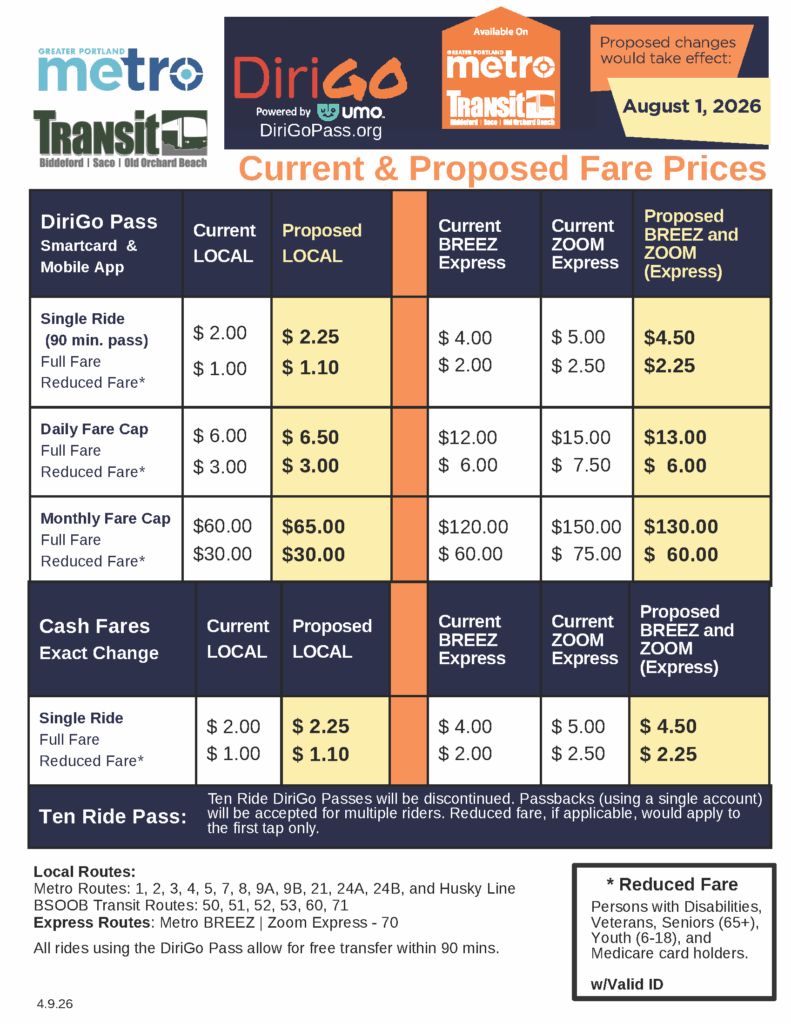
Metro proposes a base fare change to $2.25, from $2.00. Reduced fares would also increase, to $1.10 (from $1.00). These proposed base fares amount to increases of 12.5% for full-fare riders and 10% for reduced fare riders for single trips; for reference, our last fare change in 2020 was a 33% increase.
Fares for the Metro BREEZ would increase at the same rate, to $4.50 (from $4.00) for full-fare passengers and to $2.25 (from $2.00) for reduced-fare passengers.
Fares for the BSOOB ZOOM service would decrease to match BREEZ fares. Full-fare ZOOM fares would decrease to $4.50 (from $5.00) while reduced fares would decrease to $2.25 (from $2.50).These proposed fares consider numerous factors, including cost burden on riders, agency revenue, and additional cash needed.
How will this benefit Metro?
While we understand that increased fares can be an added burden on our riders, and often results in decreased overall ridership, Metro needs additional funding in order to continue operating our system at its current level of service and continue to expand and enhance service for our passengers. While we are working hard to maximize revenues from state and federal sources, increased fare revenue will help to move Metro forward.
Since 2020, Metro and BSOOB have established fare caps for frequent riders. Similar to an unlimited-ride daily or monthly pass, these caps provide an upper limit on an individual rider’s costs. Unlike a pass, however, riders are not required to pay the full amount up-front. Metro and BSOOB were early adopters of this practice, which has since become an industry standard. Fare capping is only available for DiriGo Pass (card or app) users.
Like base fares, our fare caps are also proposed to increase. In order to reduce the impact on our most frequent riders, these increases are at a lesser rate than our base fare increases.
Full-Fare Passenger Fare Caps
The daily fare cap for full-fare passengers would increase to $6.50 (from $6.00) for local rides, and to $13.00 (from $12.00) for BREEZ riders. These amount to an 8.3% increase, somewhat less than the base fare increase. BSOOB ZOOM fare caps would decrease to $13.00 from $15.00, a reduction of about 13%.
The monthly fare cap for full-fare passengers would increase to $65 (from $60) for local rides, and to $130 (from $120) for BREEZ riders. These amount to an 8.3% increase, somewhat less than the base fare increase. BSOOB ZOOM fare caps would decrease to $130 from $150, a reduction of about 13%.
Reduced Fare Passenger Fare Caps
In order to reduce the impact on our reduced fare riders, Metro and BSOOB are proposing no changes to our current fare caps for reduced fare passengers.
Currently, daily and monthly fare caps are equal to 3 rides per day and 30 rides per month on a given service, respectively. Under this proposal, daily and monthly fare caps would be just under 3 rides per day and 29 rides per month, respectively. If adopted, passengers reaching these fare caps would pay a partial fare up to the applicable fare cap. For example, a full-fare passenger who paid for 28 local trips in a month ($63) would pay just $2 for their 29th trip that month, and would not pay a fare for any subsequent trips.
How will this benefit Metro?
Metro strives to be the transportation mode of choice for Greater Portland. While fare increases can be a burden on our riders, we want to continue to encourage frequent riders to ride transit as often as they need to. Increasing fare caps at a lower rate than our base fare changes will help to keep our most frequent passengers moving.
In Summer 2026, Metro and BSOOB plan to introduce “Tap to Pay”, sometimes referred to as “open fare payments”. This will enable all passengers to pay their fare directly on board using a credit card, debit-card, or wallet-enabled smartphone (e.g. Apple Pay and Google Wallet). No need to carry cash, add stored value to an account, or download any additional apps — perfect for visitors, tourists, and infrequent riders.
How will this help Metro?
Passengers who have a payment card will be able to pay and board without any pre-planning. Someone walking a mile to their destination may opt to hop on an approaching bus instead, without the need to produce exact change or pre-load value onto an account. It can be difficult to encourage visitors, especially tourists, to ride if there are any barriers to doing so. As a result, Metro hopes that open fare payments will increase ridership by up to 5%, while generating revenue that can be used to improve the system for all.
Tap-to-pay can help reduce fare evasion by providing another acceptable payment method for those who may find themselves short on DiriGo Pass stored value or cash.
Incentives to Continue Using the DiriGo Pass
Because Metro and BSOOB will incur additional transaction fees for all tap-to-pay transactions, we will continue to encourage use of the DiriGo Pass system. Each tap-to-pay ride be charged the full base fare amount. Users interested in reduced fare benefits, free transfers, and fare capping are encouraged to register for the DiriGo Pass.

The 10-ride pass was reintroduced in 2022 to help passengers pay for multiple rides using the same account. Metro and BSOOB plan to simplify our fare payment options by eliminating the 10-ride pass and enabling passengers to “pass back” their DiriGo payment method or “tap-to-pay” credit card to pay for multiple passengers in their party.
“Passbacks” duplicate the major advantage of the 10-ride pass: paying for multiple passengers. This feature was not available when Metro and BSOOB introduced the DiriGo Pass fare payment system in 2020. With passbacks enabled, a single passenger can pay for their entire party with their stored value, with no need to buy specific passes.
How does this help Metro?
While the 10-ride pass is convenient and cost-effective for some, it adds significant complication to our fare policy. It requires Metro and BSOOB to stock numerous paper token types (Full-fare and reduced fare tokens for each local, BREEZ, and ZOOM — 6 pass types in total). With passbacks enabled, there is little benefit for this extra complication. Additionally, partially used 10-ride passes cannot be transferred when a card is lost or stolen, unlike stored value.
Implications for Passengers
The 10-ride pass is currently sold at a 10% discount, providing a small benefit to those who pay up-front for a large number of rides. Because 10-ride passes do not receive fare capping benefits, this discount is not as significant for frequent riders. Infrequent, full-fare riders who do not ride enough to receive fare capping benefits would see their effective fare increase by 25% for local and BREEZ fares (e.g. from $1.80 per ride to $2.25 per ride for full-fare, local trips). Those who use the 10-ride pass but ride frequently enough to see fare capping benefits will likely save money by switching to stored value.
On the other hand, the ability to use passbacks on stored value accounts should improve the flexibility of the system for passengers who sometimes ride with others, who may currently feel “locked in” to the 10-ride pass. With passbacks enabled, all Metro and BSOOB rides can be paid for using stored value only.
Transfers
Passengers using DiriGo Pass will continue to purchase a 90-minute pass upon boarding. Passengers can board any other bus in the DiriGo system for free (or for the difference in cost for express routes) within that 90-minute window. Changes to this window were considered as part of this process; however, at this time, Metro and BSOOB do not propose changing the 90-minute transfer window.
Metro and BSOOB are proposing no changes to the current policy of not extending free transfers to cash-paying riders. Allowing for free transfers for those paying in cash would require bus operators to issue transfer tickets. In addition to additional administrative costs, this would also slow buses down, making the service less appealing for everyone. Cash users are encouraged to get a free DiriGo Pass card or mobile app to enable free transfers. Value can be added to DiriGo accounts using cash at our 21 Elm Street and at participating 7-Eleven, CVS, and Walgreens locations in the region.
Microtransit Fares
Metro and BSOOB are continuing to consider possible changes to fares for microtransit users. Currently, passengers using Metro Connect and BSOOB QuickRide pay the same base fare as local trips. However, the cost to the agencies per passenger trip is higher on microtransit than for most fixed routes, so a higher fare may be justified. Metro and BSOOB will determine whether microtransit fares will change as part of this fare policy update, and publicize before any changes are implemented.
Cash payments
Metro and BSOOB did not consider going “cash-free” or consider any other policy, aside from the proposed fare changes, that affect passengers who prefer to pay with cash on board. Cash will continue to be an acceptable form of payment for the foreseeable future; however, we continue to encourage cash-paying riders to switch to DiriGo Pass to save money when riding frequently or making transfers.
Income-eligible reduced fare
Metro is exploring the possibility of extending reduced fares for those who qualify based on income. If adopted, Metro and BSOOB would seek partnerships to help verify income and administer the program. In the short-term, Metro and BSOOB are partnering with Cumberland County Public Health for a limited pilot project to help determine how users’ mobility is improved by improved access to transit. More information on how income-based reduced fare may be extended to the general public will be made available at a later date.
Background
Greater Portland Metro and BSOOB Transit last updated our fares in 2020. Prior to 2020, Metro’s fare had been $1.50 for about 10 years. As part of the 2020 fare update, Metro partnered with BSOOB Transit and South Portland Bus Service (now part of Metro’s system) to create a unified, electronic fare payment system with a $2.00 base fare. This process also resulted in the introduction of fare capping, free electronic transfers, and account-based pass programs, all of which have helped riders who ride more save money.
As part of the 2020 fare update, Metro’s Board of Directors set a goal to review fares more often to reduce the severity of fare increases when they do happen. It has now been almost six years since the last update.
Metro’s budget is funded, in part, by fare revenues. Historically, about 20-25% of Metro’s budget has been funded by fare revenues. Since 2020, in the wake of the COVID-19 pandemic and the slow rate of ridership recovery, Metro’s budget has increasingly become more reliant on direct contributions by our member communities. Updating our fares will help to reduce Metro’s burden on local funding. Metro is optimistic that changes to our fare policy will help ensure that regular riders who use Metro often will see a relatively small impact.
Goals of Fare Policy Update
Metro has several goals and expectations for our fare policy update, including:
- Generate additional farebox revenue to allow Metro to continue operating existing service levels and support future expansion
- Minimize impacts to frequent passengers
- Minimize impacts to passengers with disabilities, seniors, and other reduced fare passengers
- Explore how we can make fare payment simpler and more user friendly for our passengers; see below.
Frequently Asked Questions
- When would fare policy changes take place?
Metro is targeting fare policy changes on August 1, 2026. More details on possible dates for fare policy changes will be publicized as the process proceeds. - Is BSOOB Transit participating?
Yes, Biddeford Saco Old Orchard Beach Transit (BSOOB Transit) is participating in this policy update. Metro and BSOOB will continue to have a single fare payment system, fare policies, and DiriGo pass wallets. BSOOB Transit is planning to hold a pubic meeting on Monday, April 13, 2026 from 4:00pm-5:00pm at the Saco Transportation Center. - Aside from a possible fare increase, how would Metro generate additional revenue from policy changes?
Metro acknowledges that our electronic fare payment system, which was introduced in 2020, makes it difficult for some potential passengers to ride transit, particularly visitors to the Portland area and those traveling in groups. A major goal of this policy update is to make it simple and easy for anyone to ride Metro by allowing direct credit card payments (“tap to pay”), rather than needing cash or a DiriGo account. When more people take Metro, this increases Metro’s revenues regardless of the base fare amount, and this has other long-term benefits to Metro’s federal funding allocation as well.
How can I learn more about the project?
Metro is planning three public meetings, including two in-person meetings in Portland and Westbrook, as well as one virtual meeting.
Meeting dates include:
- Thursday, April 9: 3:30 pm – 5:30 pm; Portland Public Library, 5 Monument Sq., Rines Auditorium
- Saturday, April 11: 11:00 am – 1:00 pm; Westbrook Community Center, 426 Bridge St., Elm Room
- Tuesday, April 14: 6:00-7:00 pm; Virtual Meeting — Click Here to join. Zoom meeting ID: 849 2331 6217; Passcode 998777
BSOOB Transit is planning to hold a public meeting on:
- Monday, April 13: 4:00 pm – 5:00 pm at the Saco Transportation Center.
Help us spread the word about these public meetings.
Download flyer to post and share with riders and stakeholders.
Metro staff will also bring this item to the following Metro Board of Directors meetings:
- Wednesday, May 13: 3:30 pm, Metro Marketing and Communications Committee — Review public feedback to date and review draft final proposal
- Wednesday, May 20, 10:30am, Metro Planning and Operations Committee — Review public feedback to date and review draft final proposal
- Thursday, May 28: 4:00 pm, Metro Executive Committee — Possible recommendation of updated fare policy for full Board approval
- Thursday, June 25: 4:00 pm, Metro Board of Directors — Possible adoption of updated fare policy
There are several ways you can provide feedback on this project outside of the public-comment periods.
Contact the project manager directly:
Mike Tremblay, P.E.
Director of Transit Development
E-mail: mtremblay@gpmetro.org
Phone: (207) 517-3023
Submit Public Feedback
Metro and BSOOB Transit will conduct a full slate of public feedback on our proposed fare policy update (see dates and times above).
In the meantime, you can submit your comments and concerns in the form below.
Metro – BSOOB Fare Policy Update Feedback
Thank you for your interest in Metro’s Fare Policy Update. Please use the form below to add your email address to our mailing list, and to provide you feedback on the project.