
Gorham-Westbrook-Portland Bus Rapid Transit Design

This is the project logo, which includes the town names of Gorham, Westbrook, and Portland, and the words bus rapid transit design.

Gorham-Westbrook-Portland Bus Rapid Transit Design
What is this project?

Greater Portland Metro is in the conceptual design stage of the future Gorham-Westbrook-Portland rapid-transit service, which will be the Greater Portland Region’s first rapid-bus project. ‘Conceptual design’ means designers are identifying where rapid-bus stations, bus lanes, and other infrastructure will be roughly located in Gorham, Westbrook, and Portland.

The project plans to connect Gorham to Westbrook via State Route 25 (also known as Main Street in Gorham, and Conant Street/William Clarke Drive in Westbrook), and Westbrook to Portland via Main Street, Brighton Avenue, Deering Avenue, Congress Street, and Franklin Street. The map below shows the planned alignment, which is currently being finalized.
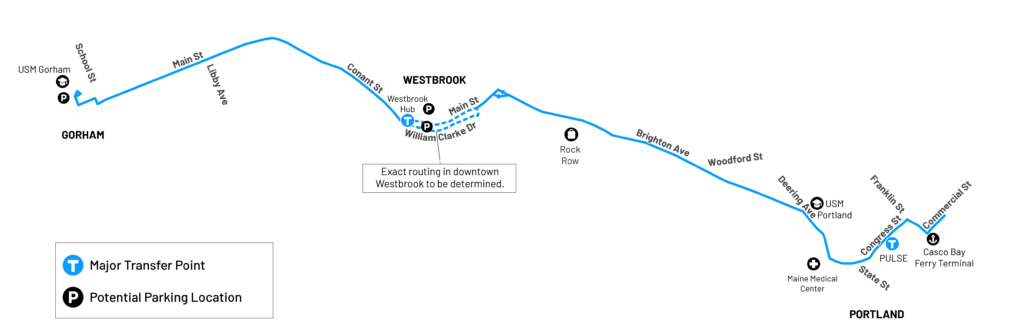
A map showing a proposed rapid transit alignment between Gorham, Westbrook, and Portland. Major transfer points and destinations are included on the map. From west to east, this alignment connects USM Gorham, Gorham Village, downtown Westbrook, Rock Row, USM Portland, Maine Medical Center, downtown Portland, and the Eastern Waterfront

This rapid-transit line is planned to operate every 10 minutes on weekdays, carrying 4,600 average daily passenger trips, and serving 51,000 jobs and 47,000 residents. The service is planned to operate seven days a week, starting service as early as 5:00 a.m. and ending service as late as 11:30 p.m.

What is the project’s purpose and its goals?

The purpose of this project is to provide fast, reliable, and frequent transit service that connects Gorham, Westbrook, and Portland’s major transportation and activity centers. The project’s goals and objectives are below.

Focus on Practical and Implementable Solutions

Grow Transit Ridership

Support Sustainable Growth

Enhance Connectivity

Provide New Opportunities

Improve Mobility

Focus on Equity

What is bus rapid transit? 

Bus rapid transit is a form of public transportation with features that significantly improve the speed, reliability, and quality of service. The graphic below shows typical features of a rapid-transit system, including off-board fare collection, branded vehicles and stations, transit signal priority, and bus lanes.
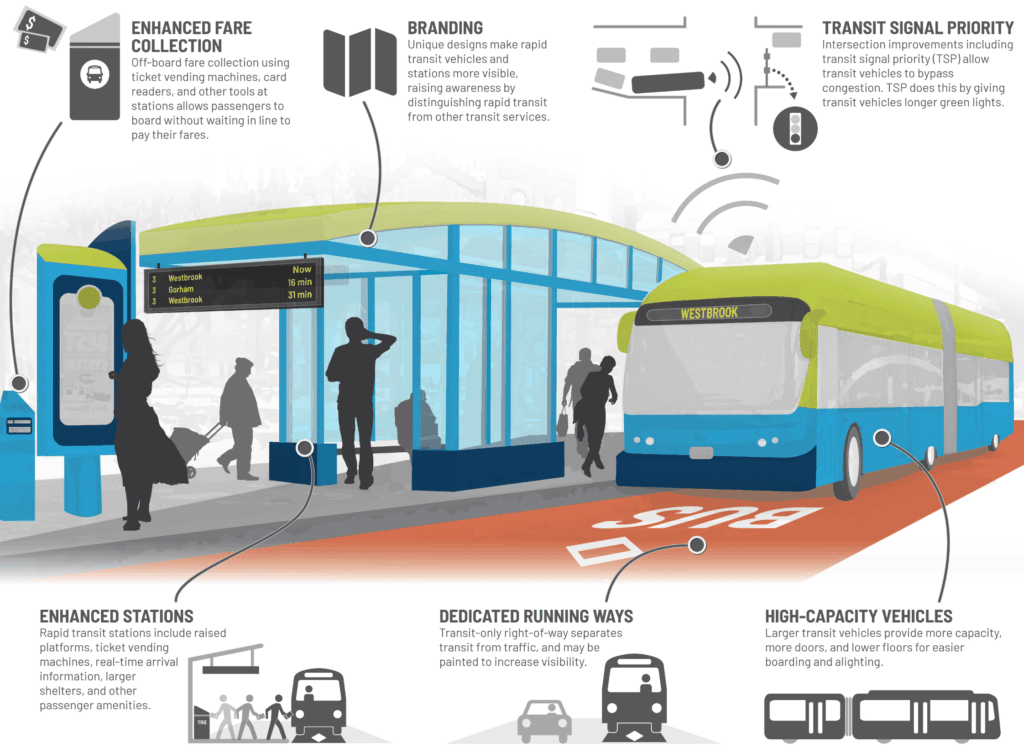
This graphic shows the components of a bus rapid transit system. These are: Enhanced Fare Collection: Off-board fare collection using ticket vending machines, card readers, and other tools at stations allows passengers to board without waiting in line to pay their fares. Branding: Unique designs make rapid transit vehicles and stations more visible, raising awareness by distinguishing rapid transit from other transit services. Transit Signal Priority: Intersection improvements including transit signal priority (TSP) allow transit vehicles to bypass congestion. TSP does this by giving transit vehicles longer green lights. Enhanced Stations: Rapid transit stations include raised platforms, ticket vending machines, real-time arrival information, larger shelters, and other passenger amenities. Dedicated Running Ways: Transit-only right-of-way separates transit from traffic, and may be painted to increase visibility. High-Capacity Vehicles: Larger transit vehicles provide more capacity, more doors, and lower floors for easier boarding and alighting.

Where are we now?

This project is currently in the conceptual design phase. During this phase, Greater Portland Metro will:

Greater Portland Metro is working on this project with municipal staff from Gorham, Westbrook, and Portland, as well as planners from the Maine Department of Transportation, the Maine Turnpike Authority, and the Greater Portland Council of Governments. Metro will also conduct public outreach and dedicated stakeholder engagement to further inform the project’s design.

This phase of the Gorham-Westbrook-Portland Rapid Transit project is scheduled to run through June 2026, with future design phases to follow.

What is the project’s schedule?
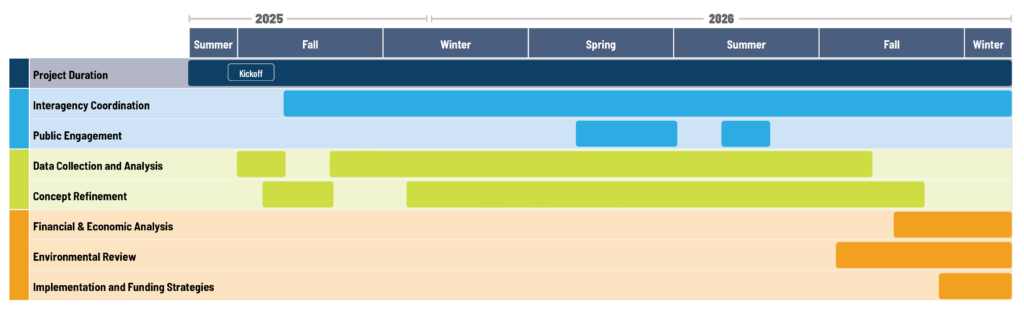
This graphic shows the project schedule. The project is scheduled to run from Summer 2025 to Winter 2026. Interagency coordination will begin in mid-Fall 2025 and conclude at the end of the project. Public engagement will occur in Spring and Summer of 2026. Data collection and analysis will span all of 2025 and through Fall 2026. Concept refinement will begin in Fall 2025 and continue through Fall 2026. Additional analysis, like the financial and economic analysis, environmental review, and implementation and funding strategies, will occur primarily in the Fall and Winter of 2026.

What is the project’s background?

This project originates in our region’s long-range transit plan, Transit Tomorrow, which calls for a rapid-transit network that meets our growing transportation needs without building major new roads or producing more traffic congestion.

After Transit Tomorrow, the Greater Portland Council of Governments, Greater Portland Metro, Gorham, Westbrook, and Portland collaborated on the Gorham-Westbrook-Portland Rapid Transit Study, which ultimately identified this project’s Locally Preferred Alternative. This Locally Preferred Alternative was approved by the Portland Area Comprehensive Transportation System’s Policy Board on January 25, 2024.

What public and stakeholder engagement has been conducted to date?

During the Gorham-Westbrook-Portland Rapid Transit Study, the planning team engaged over 2,000 people through public meetings, pop-up events, online surveys, and stakeholder interviews. Public support for the Locally Preferred Alternative was exceptionally high; in a survey of nearly 600 respondents, more than 85% of participants indicated support for the project. The LPA is also supported by the University of Southern Maine.

In spring 2026, the planning team conducted pop-up events at six locations total in Gorham, Westbrook, and Portland, and conducted a survey that received over 700 responses.

The Gorham-Westbrook-Portland rapid-transit line aligns with the goals of several other state, regional, and local plans, including: Maine Won’t Wait, Connect 2045, and Portland and South Portland’s One Climate Future.

Frequently Asked Questions

The alignment was selected through a multi-year planning process that evaluated several potential corridors. It was chosen in part because it connects many key destinations, like University of Southern Maine, Maine Medical Center, downtown Westbrook, and downtown Portland along a single continuous corridor. This alignment also has significant existing ridership, meaning the project will provide immediate benefit for people who ride current service. Several alternative corridors, such as New Portland Road, Warren Avenue, and Forest Avenue were evaluated but not selected. Key factors contributing to alignment selection included travel time, reliability, ridership, and cost. Greater Portland’s regional transportation agency, the Portland Area Comprehensive Transportation System (PACTS) voted to approve the alignment. 

The same multi-year planning process that led to the selected project alignment also explored rail- and bus-based alternatives, including the potential to use existing rail corridors for rapid transit. This included an evaluation of the costs and benefits of each mode. Existing rail corridors were not recommended for rapid transit due to current use by freight and Downeaster passenger rail services, limited access to key destinations, environmental impacts to sensitive sites, and susceptibility to sea-level rise. Similarly, a new street-running rail service was estimated to be several times more expensive than rapid-bus alternatives, more costly to operate, and unlikely to produce enough ridership to justify the additional cost. Overall, BRT can provide similar benefits to street-running rail service at a substantially lower per-rider cost. 

The current phase of the project is refining the alignment and station locations. This phase of work is scheduled through the end of 2026. After that, the project will advance through preliminary and final design, which typically takes 12-18 months. Construction is slated to take another two to three years. Each of these phases is dependent on funding, with funding presumed to come from (to be determined) local, state, and federal funding sources. In the meantime, Metro will continue partnering with the municipalities of Gorham, Westbrook, and Portland, as well as USM, on short-term improvements to the Husky Line. 

This project will replace the Husky Line with a more frequent service that operates for more hours of the day. The goal of BRT is to make service so frequent and reliable that checking a schedule is unnecessary. Route 4 will continue to serve local destinations on the corridor. The project team will review other Metro services that overlap with the project corridor to consider opportunities for stronger connections between routes in the network. 

Gorham-Westbrook-Portland BRT is planned as the first rapid-bus service in Greater Portland, but it is also envisioned as the start of a broader rapid-transit network with corridors radiating from Portland to points north (Brunswick), northwest (Windham), and south (South Portland and Biddeford-Saco). You can learn more about the region’s plans for a rapid-transit network in Greater Portland’s long-range transit plan, Transit Tomorrow

A fare has not yet been determined for BRT. The fare will be determined as the project gets closer to implementation. 

Station locations are a main focus of the project’s current phase. General station locations (e.g., USM Gorham) have been identified, but specifics (e.g., in front of Bailey Hall, or just south of Bailey Hall) are the ongoing topic of design work and community discussion. Station placement balances several factors, such as proximity to major destinations, safe pedestrian access, spacing between stops to keep travel times competitive, and construction feasibility. Upcoming community discussion will invite feedback on preliminary station location recommendations. 

A goal of the project is to move people along the corridor more efficiently, as buses carry significantly more passengers than autos. When BRT attracts riders who would otherwise drive, that reduces the number of cars on the corridor, which benefits everyone. That said, the project is working closely with the municipalities of Gorham, Westbrook, and Portland, as well as MaineDOT, to balance transit priority with overall traffic performance, with the intent of achieving acceptable levels of service for all vehicles.  

Along with confirming station location, confirming type and location of transit priority treatments is a primary focus of the current project phase. Bus lanes provide transit reliability, but they must be balanced with competing needs for limited road space. Our goal is to provide as much transit priority as possible. Some areas may be suitable for bus lanes, while others may need to rely on other tools like transit signal priority (e.g., longer green lights for buses) to make BRT fast and reliable. The project aims to show locations of bus lane recommendations at community outreach events in July 2026. 

Any investments made in transit priority will be available to emergency vehicles. For example, transit signal priority can be used by ambulances and fire trucks, as can bus lanes and queue jumps. The project is expected to improve overall emergency-vehicle response times and the reliability of these response times. 

Yes. Improving safety for people walking and biking are complementary goals to this project. Our work will prioritize safe walking and bicycling access to stations, and we are planning for and assuming safe parallel bicycling and walking routes alongside the project, between stations. This will remain a stated project goal as the project advances through design. We recognize there are many locations on the proposed BRT alignment that are challenging for pedestrians and cyclists today and are working with municipal partners to improve safety at these locations as part of—or concurrent to—the project. We know BRT can only be successful if people are able to safely access the service. 

At this time, we assume the BRT project is working within available public roadway right-of-way. We are working with some property owners (e.g., USM) to explore easements for stations and layovers on private property. If this changes (e.g., conversations continue about a westerly park-and-ride near USM Gorham campus), any impacts to private land would follow Maine guidelines for right-of-way acquisition as stipulated in the MaineDOT Right of Way Manual and following the federal Uniform Relocation Assistance and Real Property Acquisition Policies Act.  

How can I learn more about the project?

There are several ways you can provide feedback on this project outside of the public-comment periods.

Contact the project manager directly:

Mike Tremblay, P.E.
Director of Transit Development
E-mail: mtremblay@gpmetro.org
Phone: (207) 517-3023

Gorham-Westbrook-Portland BRT Design Feedback

Thank you for your interest in the Gorham-Westbrook-Portland Bus Rapid Transit project! Please use the form below to add your email address to our mailing list, and to provide you feedback on the project.

Your Name